

A Clockwork Orange: meaning, explained ending, and key takeaways of the film
Jose Antonio Carravilla BlancoA bowler hat, white clothes, a false eyelash, Beethoven, and a healthy dose of ultraviolence. More than half a century after its release, A Clockwork Orange remains one of the most recognizable and controversial films in cinematic history.
But behind its provocative aesthetic lies a much deeper story about violence, freedom, social control, and free will.
In fact, the film's strange title pretty much sums up its entire meaning.
Why is it called A Clockwork Orange? What does the Ludovico Technique aim to achieve? Why is Beethoven so important to Alex? And what does the ending really mean?
These are the keys to understanding the meaning of A Clockwork Orange.
What is A Clockwork Orange?
A Clockwork Orange is a film directed by Stanley Kubrick and released in 1971, based on the novel that Anthony Burgess had published in 1962.
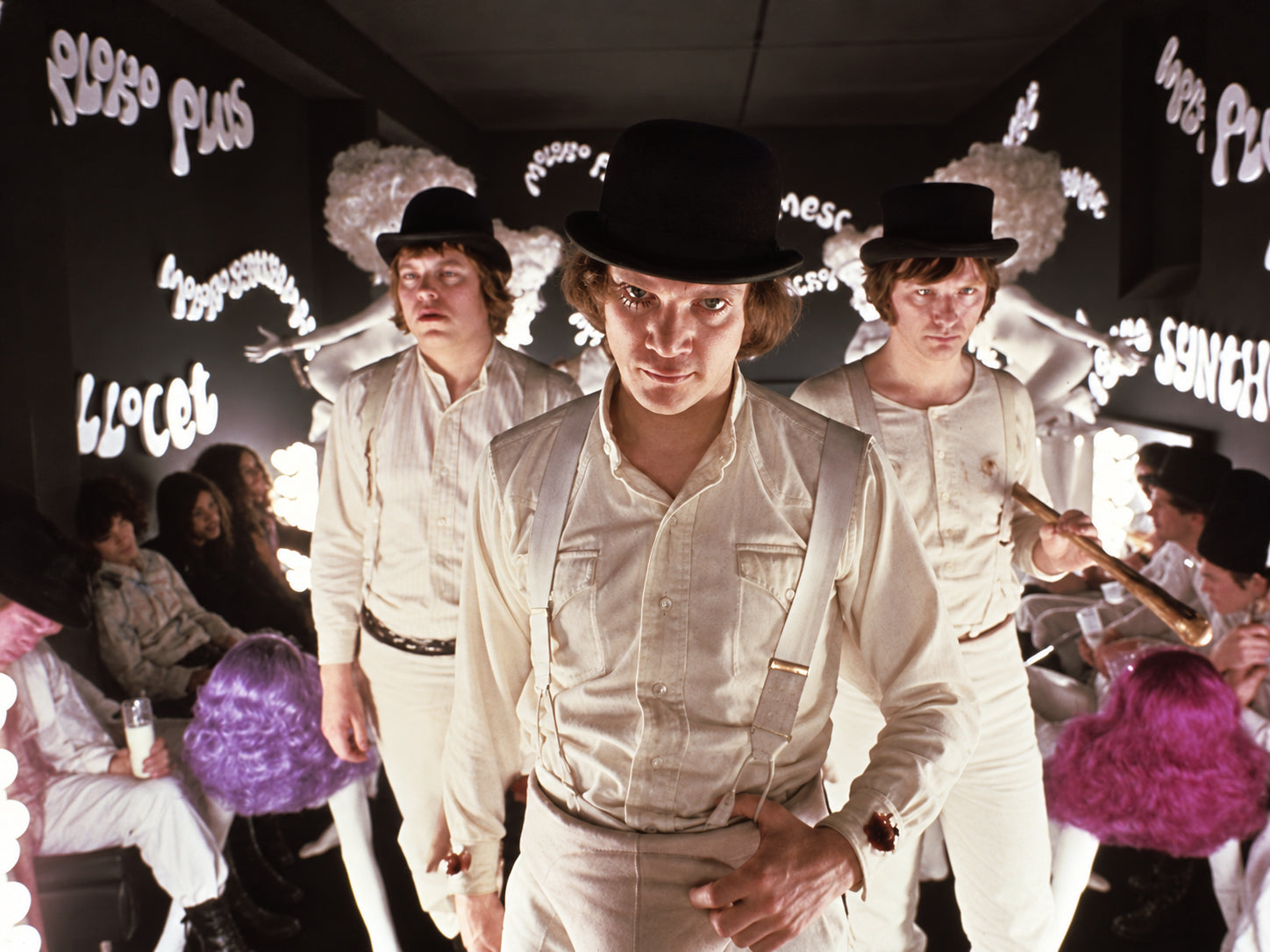
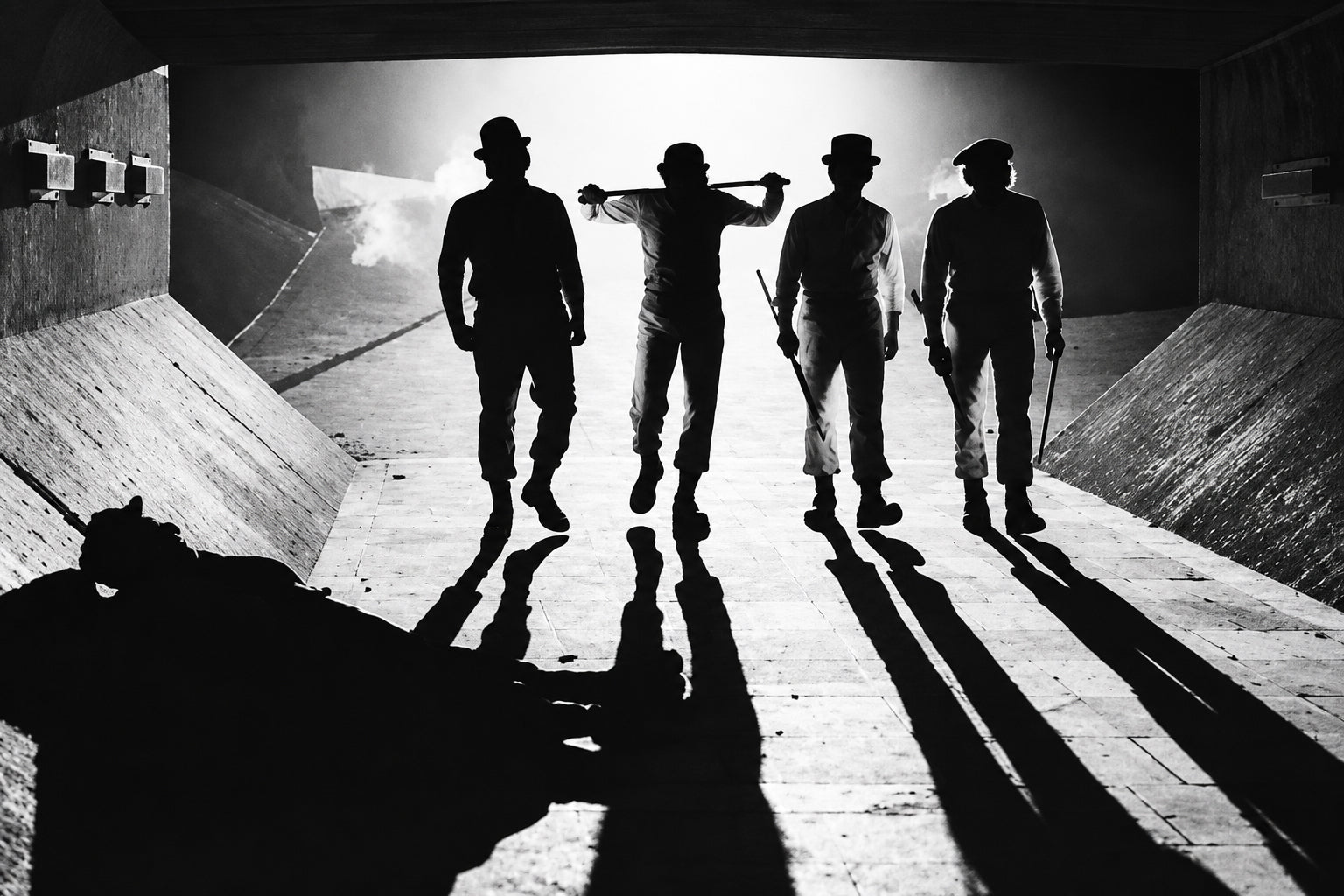
The story takes place in a futuristic British society and follows Alex, an extremely violent young man who spends his nights committing crimes with his group of friends, the so-called droogs.
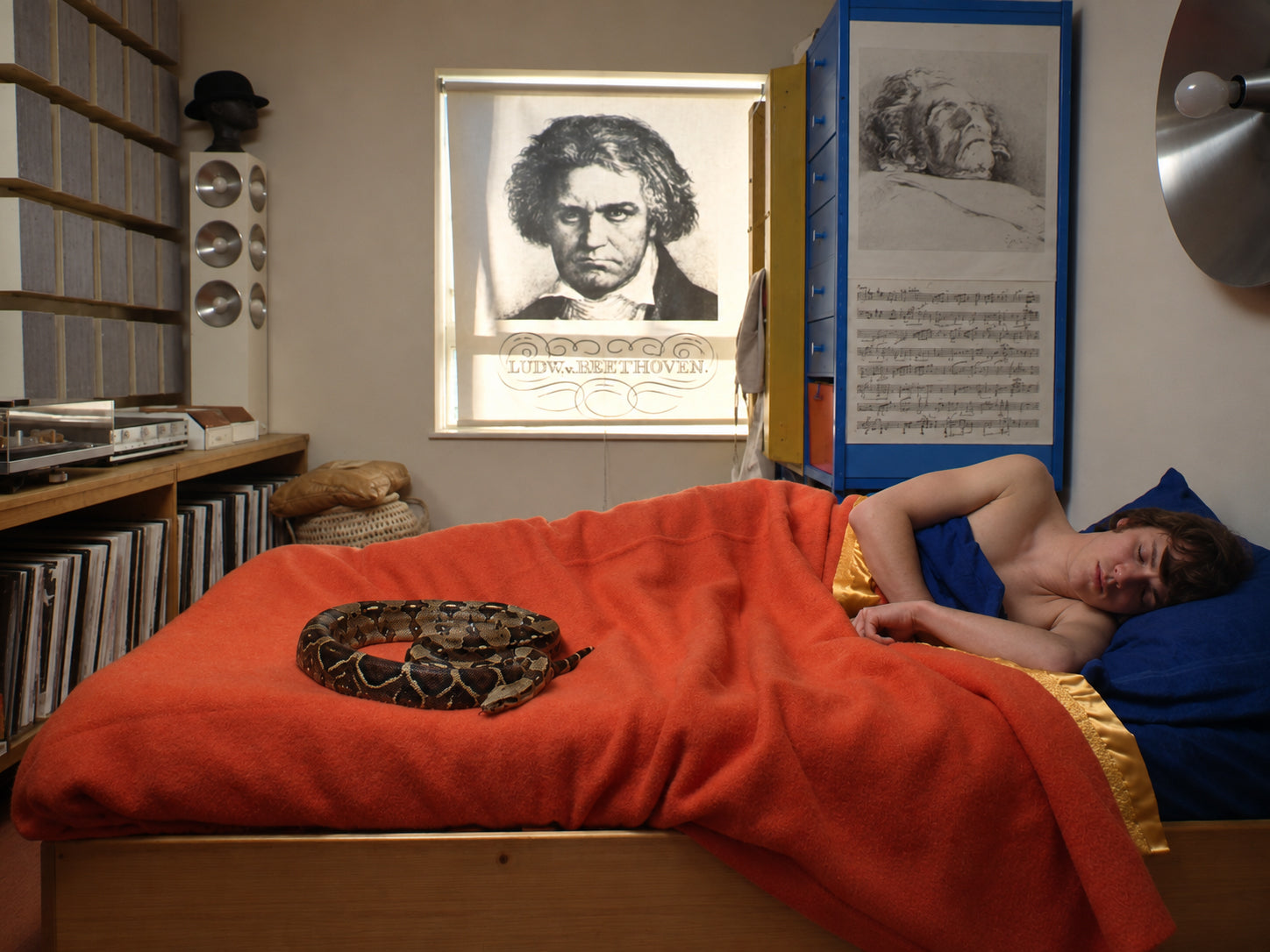
Alex also has an enormous passion for classical music, especially for Ludwig van Beethoven.
After being arrested and imprisoned, he volunteers to participate in a new experimental procedure that promises to rehabilitate criminals in a very short time.
That procedure is the Ludovico Technique.
And it is precisely there that A Clockwork Orange stops being just a story about juvenile delinquency to pose its true question:
is it preferable to have a person who chooses to do evil or a person incapable of choosing at all?
What does the title A Clockwork Orange mean?
The title may seem absurd until you understand the metaphor Anthony Burgess wanted to build.
The author explained that he had heard an English expression years earlier similar to "as queer as a clockwork orange" and decided to use it as the title of his novel.
But he added his own meaning to that expression.
An orange is something natural, organic, and alive.
A clockwork mechanism, on the other hand, functions because its parts have been configured to perform specific movements.
A "clockwork orange" would, therefore, be something living turned into a machine.
That is exactly what the State tries to do with Alex.
Through the Ludovico Technique, it aims to eliminate his capacity to behave violently. The problem is that to achieve this, it neither changes his values nor makes him repent.
It simply modifies his behavior until it turns him into something programmed.
Alex continues to be a human being on the outside, but a fundamental part of his capacity to decide has been replaced by a conditioned mechanism.
What is the real meaning of A Clockwork Orange?
One of the central themes of the film is free will: the capacity of a person to choose between different behaviors.
At the beginning of the story, Alex has the freedom to decide and uses that freedom in a terrible way.
He is violent, selfish, and practically incapable of showing empathy toward his victims.
The State's response consists of taking away precisely that which allows him to act that way: the capacity to choose.
The result presents a paradox.
After the treatment, Alex has apparently become a citizen incapable of committing violent acts.
But not because he has understood that they are wrong.
He has not experienced a moral transformation.
His body simply prevents him from doing that which he could previously choose freely.
The film thus forces the viewer to face an uncomfortable question: can we consider a person good if they have no possibility of doing evil?
What is the Ludovico Technique?
The Ludovico Technique is the experiment used to attempt to eliminate Alex's violent impulses.
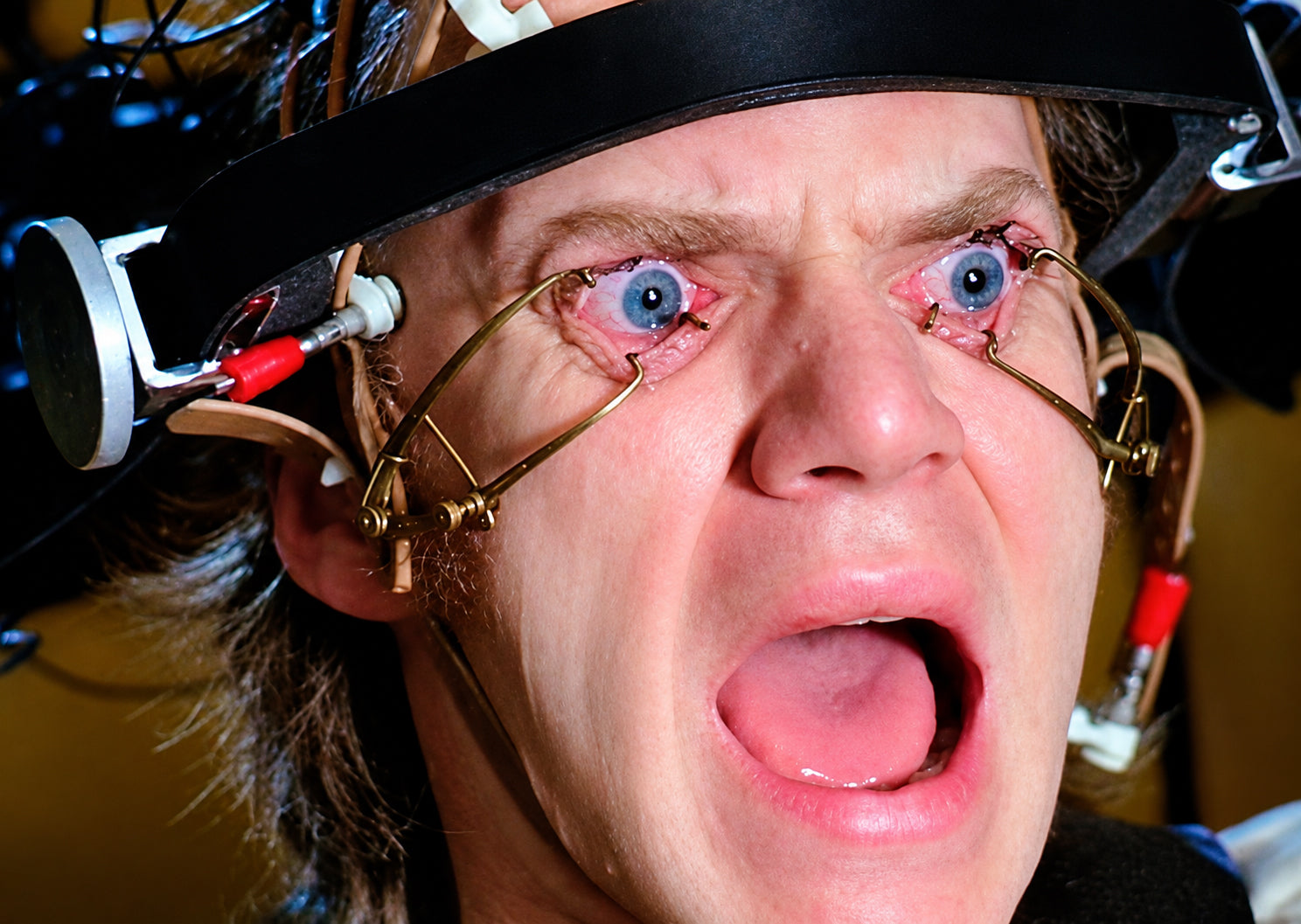
During the sessions, he is immobilized in front of a screen and forced to watch extremely violent images.
His eyelids are held open by specula to prevent him from looking away.
At the same time, he receives substances that cause him severe physical discomfort.
Little by little, his brain begins to associate the violent images with that suffering.
When he subsequently attempts to act violently, his organism automatically responds with nausea, pain, and a practically absolute incapacity to continue.
From the point of view of those who designed the experiment, Alex is rehabilitated.
From the moral point of view of the film, the situation is much more problematic.
The Ludovico Technique does not teach Alex to be good: it programs him so that he cannot be bad.
Alex: villain, victim, or both?
One of the reasons why A Clockwork Orange continues to generate debate is that Kubrick forces the viewer to continually change their relationship with Alex.
At the beginning, it is difficult to feel sympathy for him.
He is responsible for brutal acts and enjoys exercising violence.
However, after the Ludovico Technique, something strange happens.
Alex goes from being an aggressor to becoming a person incapable of defending himself.
Some of his former victims and enemies can now attack him while he is physically incapable of responding.
The film does not intend to erase the crimes he has committed.
What it poses is another problem: that someone has acted monstrously does not automatically make any method used to punish or control them moral.
That is where much of the story's discomfort lies.
Why is Beethoven so important in A Clockwork Orange?
Alex feels true devotion to Ludwig van Beethoven, especially for his Ninth Symphony.
This hobby creates one of the character's most important contrasts.
Alex can experience enormous emotion before a work of art and, at the same time, be capable of exercising extreme violence against other people.
Kubrick thus breaks the idea that someone who appreciates culture, beauty, or music necessarily possesses high morals.
But Beethoven acquires even more importance during the Ludovico Technique.
In one of the films used during the conditioning, his music appears.
Alex realizes with horror that the treatment is causing his own body to also begin rejecting that which he loves most.
The system designed to control his violence ends up invading a part of his identity that had nothing to do with his crimes.
That detail reinforces the film's critique: once the State acquires the capacity to program human behavior, it is difficult to establish where it should stop.
Why are Alex's eyes so important?
One of the most famous images from A Clockwork Orange shows Alex with his eyes wide open during the Ludovico Technique.
It is not just an image created to provoke the viewer.
For a good part of the film, there is a constant relationship between looking, choosing, and controlling.
Alex enjoys contemplating what he has chosen to see. During the treatment, however, he loses even that basic freedom.
He cannot close his eyes.
He cannot look away.
He cannot decide when to stop observing.
The image visually summarizes what is happening to the character: the control of his conduct begins by snatching away his possibility to choose.
What does A Clockwork Orange criticize?
It would be too simple to interpret the film only as a denunciation of juvenile violence.
Alex's violence is evident, but the film also examines the violence exercised by institutions.
The Government finds an apparently perfect solution in the Ludovico Technique: reducing delinquency and freeing up space in prisons.
But the political interest in demonstrating that the system works ends up being more important than the person subjected to the experiment.
Alex stops being just a criminal.
He becomes first an experiment and then a political tool.
Kubrick thus confronts two different forms of control: the chaotic violence of the individual and the organized violence of a system capable of modifying human behavior.
A Clockwork Orange ending explained
From here on there are spoilers for the ending of A Clockwork Orange.
After the Ludovico Technique, Alex returns to a society in which he is practically unable to defend himself.
His situation ends up leading him to a suicide attempt.
He survives and wakes up in a hospital.
By then, his case has become a political problem for the Government.
The authorities need to neutralize the scandal and reach an agreement with him.
But during his recovery, we discover something fundamental: the effects of the Ludovico Technique seem to have disappeared.
Alex begins imagining sexual and violent behaviors again without experiencing the terrible physical discomfort that previously prevented him.
The last scene confirms that he has recovered that which the treatment had taken away from him.
His capacity to choose.
What does the ending really mean?
The ending is deliberately uncomfortable because Alex does not end up becoming a better person.
His medical recovery also implies the recovery of his previous impulses.
That is why the concept of being "cured" has a deeply ironic meaning.
From the point of view of criminal rehabilitation, the experiment has failed.
But from the philosophical question the film poses, Alex has recovered an essential characteristic of the human being: the possibility of choosing between different actions.
The film does not state that his choices are good.
In fact, the problem is precisely that they probably are not.
What it poses is that eliminating the possibility of choosing evil also eliminates the possibility of truly choosing good.
And that is where the title finally makes sense.
While he was conditioned, Alex was that clockwork orange: a living organism whose behavior had been programmed from the outside.
Why does A Clockwork Orange remain a cult film?
Because few films are as easy to recognize with just a few elements.
The bowler hat, the white uniforms, the black boots, Alex's eyelash, Beethoven, and the aesthetic of the droogs have ended up becoming part of popular culture.
The film's influence can be found decades later in fashion, design, music, photography, and numerous references within urban culture.
The British Film Institute highlights precisely the combination of stylized interiors, Wendy Carlos's electronic music, and the language originally created by Burgess as essential elements of the film's identity.
But its permanence does not depend solely on its aesthetic.
More than fifty years later, the central questions of A Clockwork Orange still have force:
how far should the State be able to go to modify a person's behavior? Is it enough to prevent a conduct, or is it necessary for the individual to be able to decide to reject it on their own?
That is what makes A Clockwork Orange remain much more than a provocative film from the 70s.

The aesthetic of A Clockwork Orange turned into an icon
Over the years, many elements of the film have acquired an identity of their own.
Alex, the droogs, ultraviolence, the Korova Milk Bar, or Moloko Vellocet are references that a fan recognizes immediately, even without needing to show the film's title.
That aesthetic and those symbols inspire our A Clockwork Orange t-shirt collection, with designs based on some of the most recognizable references in the universe created by Anthony Burgess and brought to the screen by Stanley Kubrick.
And some of those references hide enough history to deserve their own chapter.