

How was DJ culture born? From vinyl to raves
Jose Antonio Carravilla BlancoToday, a DJ can perform in front of thousands of people at a festival, produce their own tracks, or turn a set into a true spectacle. But the figure of the DJ was born simply by playing records.
How did we go from selecting songs on the radio to mixing, scratching, creating new rhythms, and packing out clubs and raves? The history of the DJ is also the story of how a turntable ended up becoming a musical instrument.
What does DJ mean and where does the name come from?
DJ stands for "disc jockey," an expression that began to be used in the United States during the 1930s to refer to people who selected and presented records on the radio.
At that time, the job essentially consisted of choosing what music the audience would hear. There were no mixes, scratching, or the figure of the DJ as we know it today.
But that ability to select songs already made the DJ important: an intermediary between the music and the listener.
When did DJs start mixing songs?
When recorded music reached dance floors, a very simple problem appeared: how to keep people dancing when a song ends?
The solution was to use two turntables and a mixer to prepare the next record while the previous one was still playing.
In the late 60s, club DJs began to perfect techniques to join songs without interrupting the rhythm. Francis Grasso is credited with popularizing beatmatching, the technique that allows synchronizing the tempo of two records to create a much more fluid transition.
That change was fundamental: the DJ was no longer limited to playing one song after another. They were starting to build a continuous set.
1973: two turntables help change the history of hip-hop
One of the fundamental moments in DJ culture occurred on August 11, 1973, in the Bronx, New York.
At a party held at 1520 Sedgwick Avenue, DJ Kool Herc observed that the audience reacted particularly to the breaks: the instrumental and rhythmic segments of certain songs.
Using two copies of the same record on two turntables, he could switch from one break to another and lengthen a part that originally lasted just a few seconds.
Thus, the DJ stopped simply playing the song as it had been recorded. Now they could dismantle it, repeat its best fragments, and create something new live.
Those Bronx parties would eventually be considered one of the starting points of hip-hop.
Who invented scratching?
Another technique would end up definitively transforming the turntable into an instrument: scratching.
The Bronx DJ Grand Wizzard Theodore is recognized as one of its great pioneers. The technique consists of manually moving a record forward and backward while the needle remains in the groove.
Something that was originally designed solely to play music began to be used to create completely new rhythms and sounds.
The turntable was no longer just a playback device.
It had become an instrument.
From disco to house and techno
While hip-hop was transforming the way turntables were used in New York, club culture was also evolving along other paths.
In Chicago, DJs like Frankie Knuckles mixed disco, soul, electronics, and extended versions in clubs like The Warehouse. That scene would end up being fundamental to the birth of house.
In Detroit, producers and DJs developed more electronic and futuristic music that would end up shaping techno.
The DJ thus went from selecting existing music to occupying a central position in the creation of new musical genres.
Why does vinyl remain a symbol of DJs?
Today you can perform a set using controllers, digital players, and even a computer. However, two turntables, a mixer, and headphones remain the classic image of the DJ.
There is a historical reason: for decades, vinyl was the tool with which DJs learned to mix, search for breaks, scratch, and build sets.
In addition, the turntable allowed something that other players were not designed to do: physically touch the music. Stopping the record, speeding it up, rewinding it, or finding exactly the point where you wanted to start.
That is why vinyl continues to be part of the visual identity of DJ culture even in the digital age.
From the booth to raves and major festivals
With the growth of house, techno, and electronic music, the DJ progressively abandoned the role of a figure hidden in a corner of the venue.
Club culture and later raves placed increasing attention on the person controlling the music and building the experience for the entire night.
Currently, there are DJs of hip-hop, house, techno, drum and bass, EDM, and a multitude of different genres. There are also turntablists whose performance is based precisely on technical skill with turntables and the mixer.
Technology has changed, but the fundamental idea remains very similar: selecting, mixing, and transforming music to create a new experience in front of an audience.
How did DJ culture end up influencing fashion as well?
Music never stays just in the music.
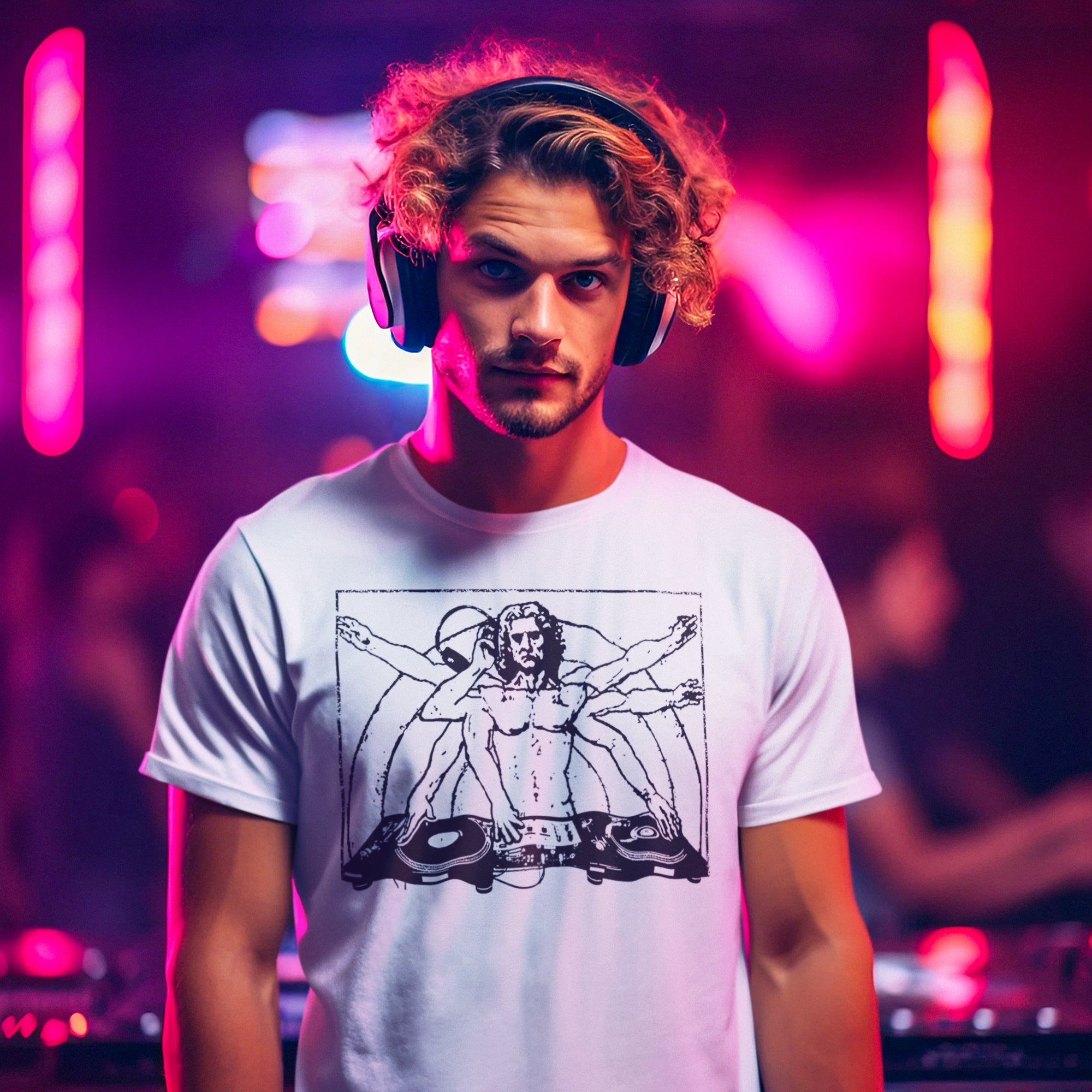
Hip-hop, techno, rave, and club culture also developed their own aesthetics, visual codes, and ways of dressing. Turntables, vinyl, headphones, equalizers, and graphics inspired by sound ended up appearing on posters, album covers, street art, and clothing.
That is why the image of the DJ is recognizable even without hearing a single song.
At Siempre Original, we reinterpret part of that universe by mixing music, art, and graphic design. You can discover our DJ Culture t-shirt collection, inspired by turntables, vinyl, hip-hop, techno, and club culture.