

What is the ideal fabric weight for a good t-shirt? 140, 150, 180, or 200 g/m²
Jose Antonio Carravilla BlancoWhen we buy a T-shirt and see figures like 140, 150, 180, or 200 gsm, it's easy to think that the higher the number, the better the T-shirt.
But it doesn't exactly work like that.
The weight (gsm) indicates the weight of the fabric per square meter, not its quality. A lightweight T-shirt can use excellent cotton, have a very soft feel, and offer great comfort without needing to be particularly thick.
The right choice depends on what you are looking for: lightness, freshness, drape, structure, durability, or warmth.
What does a T-shirt's gsm mean?
The fabric weight is usually expressed in grams per square meter (gsm) and tells us how much one square meter of the fabric used to make the T-shirt weighs.
As a general guideline:
- 140-155 gsm: lightweight or medium-light fabric.
- 160-180 gsm: medium-weight fabric.
- 180-200 gsm: more consistent and structured fabric.
- Over 200 gsm: thick and heavy T-shirt.
These categories are for guidance only, because there is no universal classification that determines exactly when a T-shirt shifts from light to medium or heavy.
Does higher gsm mean higher quality?
No. This is probably one of the most common mistakes when comparing T-shirts.
A 200 gsm T-shirt contains more fabric per square meter than a 150 gsm one, but that does not automatically mean it has better cotton, better stitching, or a superior feel.
To truly assess the quality of a T-shirt, you must also take into account:
- The quality and type of cotton.
- How it was spun.
- The softness and uniformity of the fabric.
- The tailoring and stitching.
- The cut and drape of the garment.
- Resistance to wear and washing.
- The surface on which the printing is done.
In fact, a lighter fabric made with ring-spun cotton can feel softer and more pleasant than a much heavier T-shirt made with coarser yarn.
That is why gsm should be understood as a characteristic of the T-shirt, not as a quality rating.
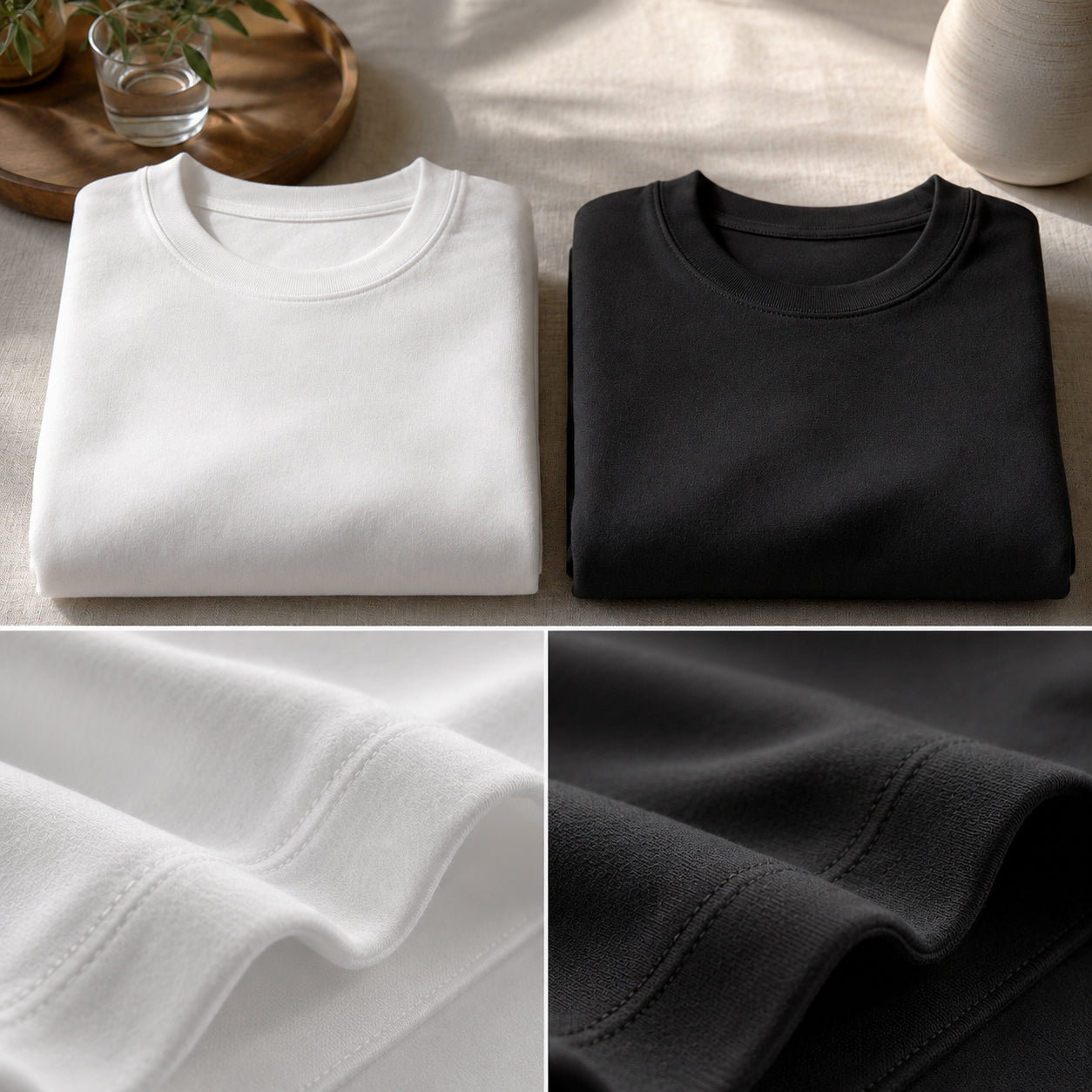
What is a 140-155 gsm T-shirt like?
This is approximately the range we use at Siempre Original.
These are T-shirts designed to offer softness, comfort, and a lightweight feel when worn, without resorting to excessively thick fabrics.
Among their main advantages, we find:
- Less weight on the body.
- Greater comfort during warm months.
- A more natural and less rigid drape.
- Ease of wearing them under a jacket, hoodie, or overshirt.
- Less volume when traveling or storing them.
- Generally faster drying than much thicker fabrics.
For a country like Spain, where a T-shirt can be worn on its own for a good part of the year, a light or medium-light weight is especially versatile.
We don't want a T-shirt to feel like a thin sweatshirt. We want you to be able to wear it for hours and feel comfortable in it.
What is a 180 gsm T-shirt like?
Around 180 gsm, we usually enter the territory of T-shirts with a more consistent feel.
The fabric usually provides more structure, more body, and a less fluid drape.
It can be a good choice for those who prefer:
- A T-shirt with a thicker feel.
- Greater visual structure.
- A more robust style.
- Wearing it in less warm seasons.
It is not necessarily better or worse than a 150 gsm T-shirt. It simply offers a different experience.
And what about 200 gsm T-shirts or heavier?
T-shirts of 200 gsm or more offer a clearly heavier fabric.
They are common in certain streetwear styles and oversized garments where it is desirable for the T-shirt to maintain a very defined silhouette.
That thickness can provide a sense of robustness and structure, but it also has some trade-offs:
- It weighs more.
- It can be warmer.
- It has a less light drape.
- It takes up more room under other garments.
- It may be excessive for certain climates or times of the year.
That's why it wouldn't make sense to always choose the heaviest T-shirt available.
The best weight is the one that fits the type of T-shirt you want to wear.
Why do we use 142 and 153 gsm T-shirts at Siempre Original?
Because we seek a very specific balance: soft, comfortable, and breathable T-shirts that you can wear for many hours, especially considering the climate in Spain.
We don't believe a T-shirt has to be very thick to convey quality. In fact, an excessively heavy fabric can be warmer, stiffer, and less comfortable for a good part of the year.
That is why we work mainly with two well-known models in textile printing: Gildan Softstyle 64000 and Bella + Canvas 3001.
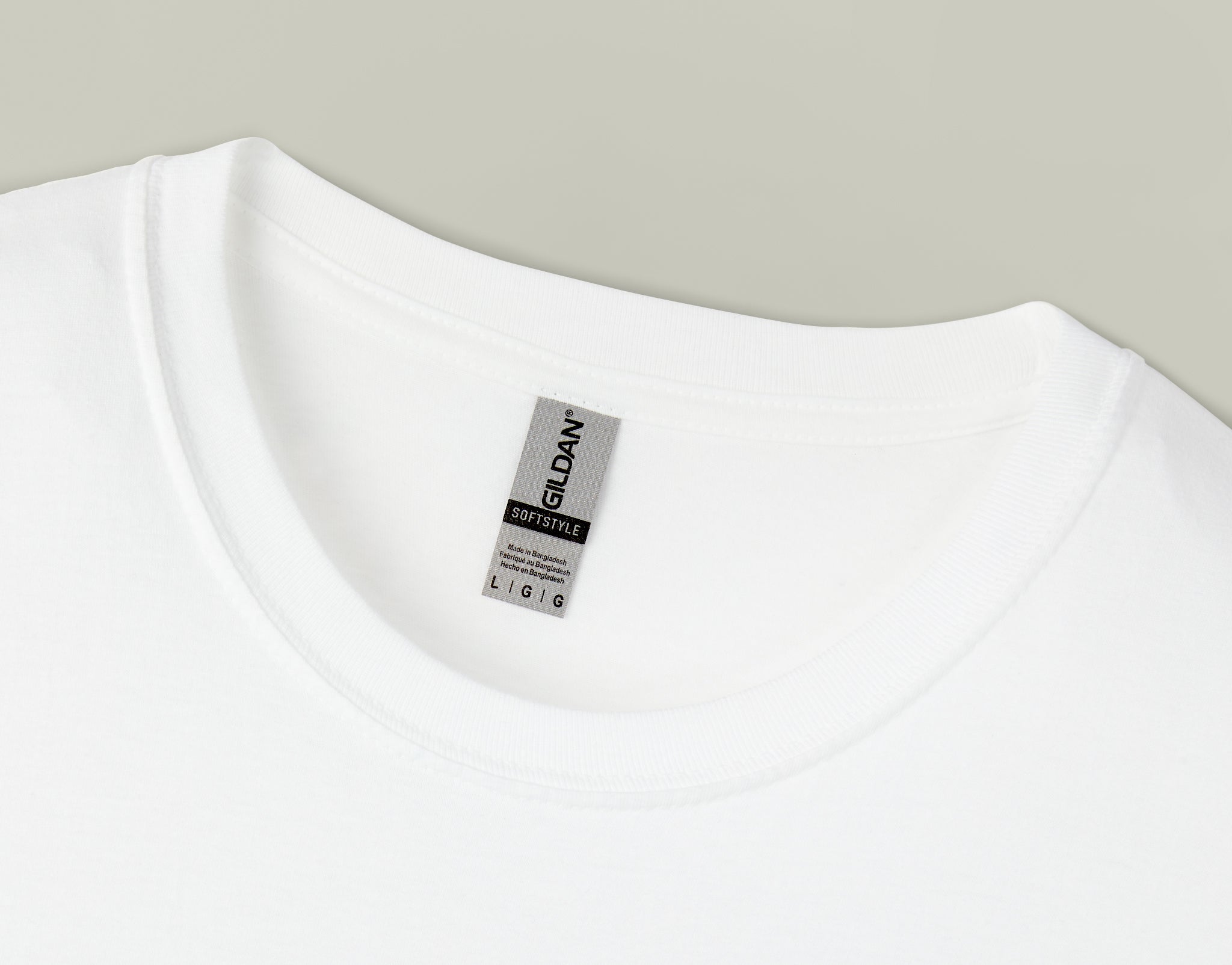
Gildan Softstyle 64000 — 153 gsm
The Gildan Softstyle 64000 is a unisex T-shirt designed to offer a soft and light feel when worn, but made with a medium-thickness fabric.
We especially like this balance because it provides enough body for the T-shirt to have a good presence without becoming a heavy or excessively warm garment.
Its ring-spun cotton fabric offers a soft touch and a uniform surface, which is especially suitable for printed T-shirts.
Additionally, the double stitching on the collar and sleeves provides greater resistance in some of the areas subjected to the most wear.
The result is a T-shirt designed to combine comfort, breathability, softness, and durability.
Bella + Canvas 3001 — 142 gsm
The Bella + Canvas 3001 has a slightly lower weight, approximately 142 gsm, and offers an especially soft and light feel.
It is made with Airlume combed and ring-spun cotton, a fabric designed to achieve a uniform and pleasant-to-the-touch surface.
It also has the right amount of elasticity to move with you without being stiff, providing a comfortable and flattering fit.
Its side-seam construction also helps to better define the T-shirt's silhouette.
It is an especially interesting option for those looking for a light, soft T-shirt with a natural drape.
Which weight is best for summer?
For high temperatures, it is generally more comfortable to use lightweight and breathable fabrics than very thick garments.
This makes the 140-155 gsm range an especially interesting option for T-shirts that will be worn during spring and summer.
And in a climate like the Spanish one, this characteristic makes even more sense.
A lightweight T-shirt can be worn on its own when it's hot, and when temperatures drop, it easily works as a base layer under a jacket, hoodie, or overshirt.
The result is a much more versatile T-shirt throughout the year.
Which weight is best for printed T-shirts?
There is no magic number either.
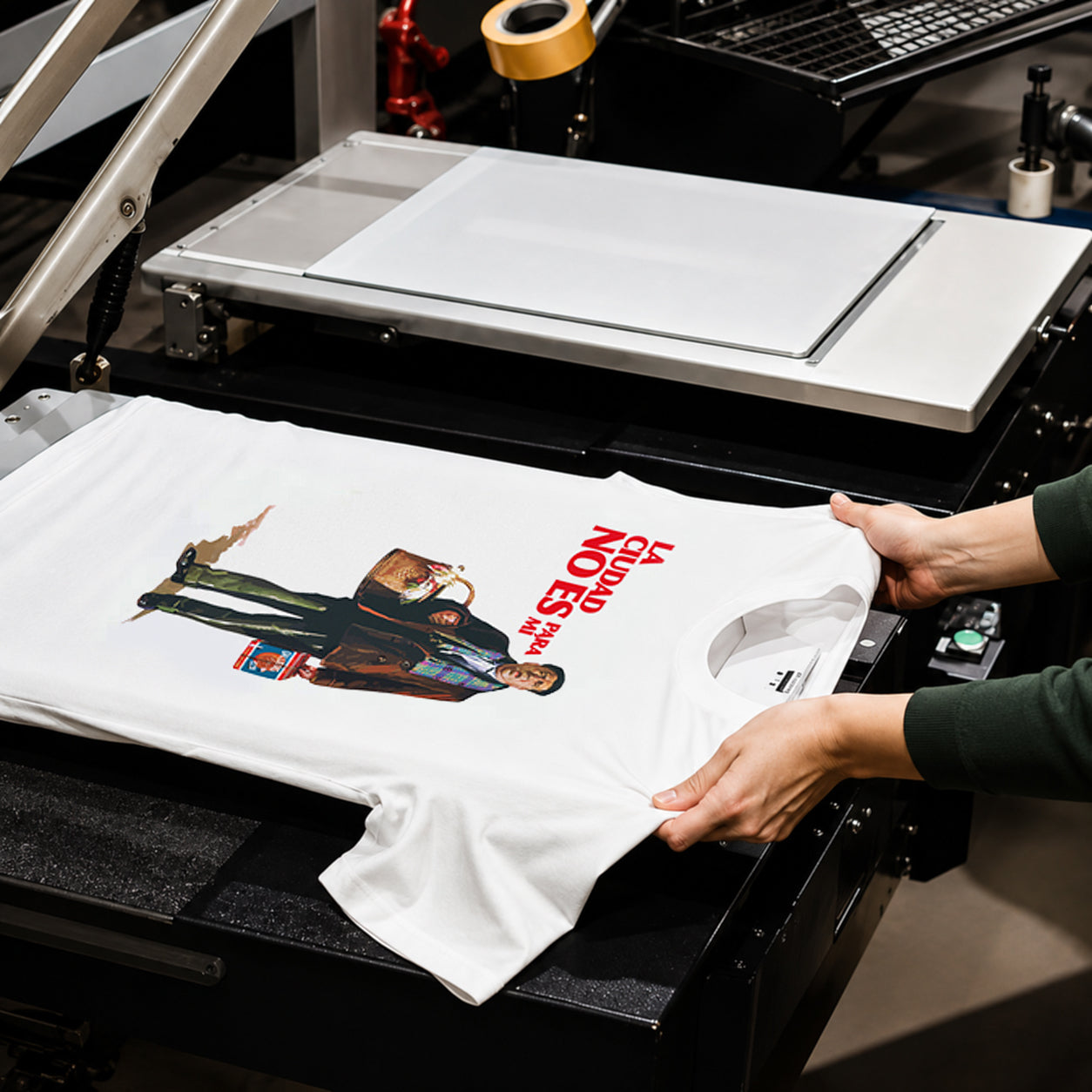
To achieve a good print, it is especially important that the fabric has a uniform surface suitable for the printing technique used.
That is why both Gildan and Bella + Canvas pay special attention to the construction of the cotton in these models.
The Gildan Softstyle uses ring-spun cotton and a smooth surface, while Bella + Canvas uses its Airlume combed and ring-spun cotton to achieve a uniform and soft fabric.
It is, therefore, possible to obtain sharp prints on lightweight T-shirts without needing to use 180, 200, or 220 gsm fabrics.
Is a lightweight fabric transparent?
Not necessarily.
Transparency depends on the weight, but also on the color, type of cotton, fabric construction, knit tension, and fit on the body.
A light white T-shirt may naturally show more than a black one of the same weight, especially if it is worn very tight.
That is why the gsm number should not be used solely to determine whether a T-shirt will have more or less coverage.
So, what weight should I choose?
As a general guideline:
- 140-155 gsm: lightness, softness, warm climate, and everyday use.
- 160-180 gsm: balance between lightness and greater structure.
- 180-200 gsm: more consistent and robust feel.
- Over 200 gsm: thick and structured garments, especially popular in certain streetwear styles.
But remember that comparing T-shirts solely by their weight is like comparing cars solely by their weight: the data says something about the product, but it doesn't determine on its own which one is better.
Why we choose these weights
At Siempre Original, we could use 200 or 220 gsm T-shirts simply to advertise a higher weight.
But more weight does not automatically mean more quality.
Our T-shirts are designed to be garments you'll actually want to wear: soft, comfortable, breathable, and easy to wear for many hours.
The Gildan Softstyle 64000 combines a soft and light feel with a 153 gsm medium-thickness fabric, while the Bella + Canvas 3001 opts for an even lighter, softer, and more flexible feel with its 142 gsm.
These are especially versatile weights for the Spanish climate: comfortable when it's hot and easy to combine under a jacket, hoodie, or overshirt when temperatures drop.
That is why our choice does not start from trying to find the heaviest T-shirt, but from finding the balance between fabric quality, softness, breathability, drape, resistance, and comfort.
Because a good T-shirt shouldn't prove its quality only with a gsm number. It should prove it when you put it on.
You can discover our designs at Siempre Original.