

Fistro, sinner, I can't... what did the words of Chiquito de la Calzada mean?
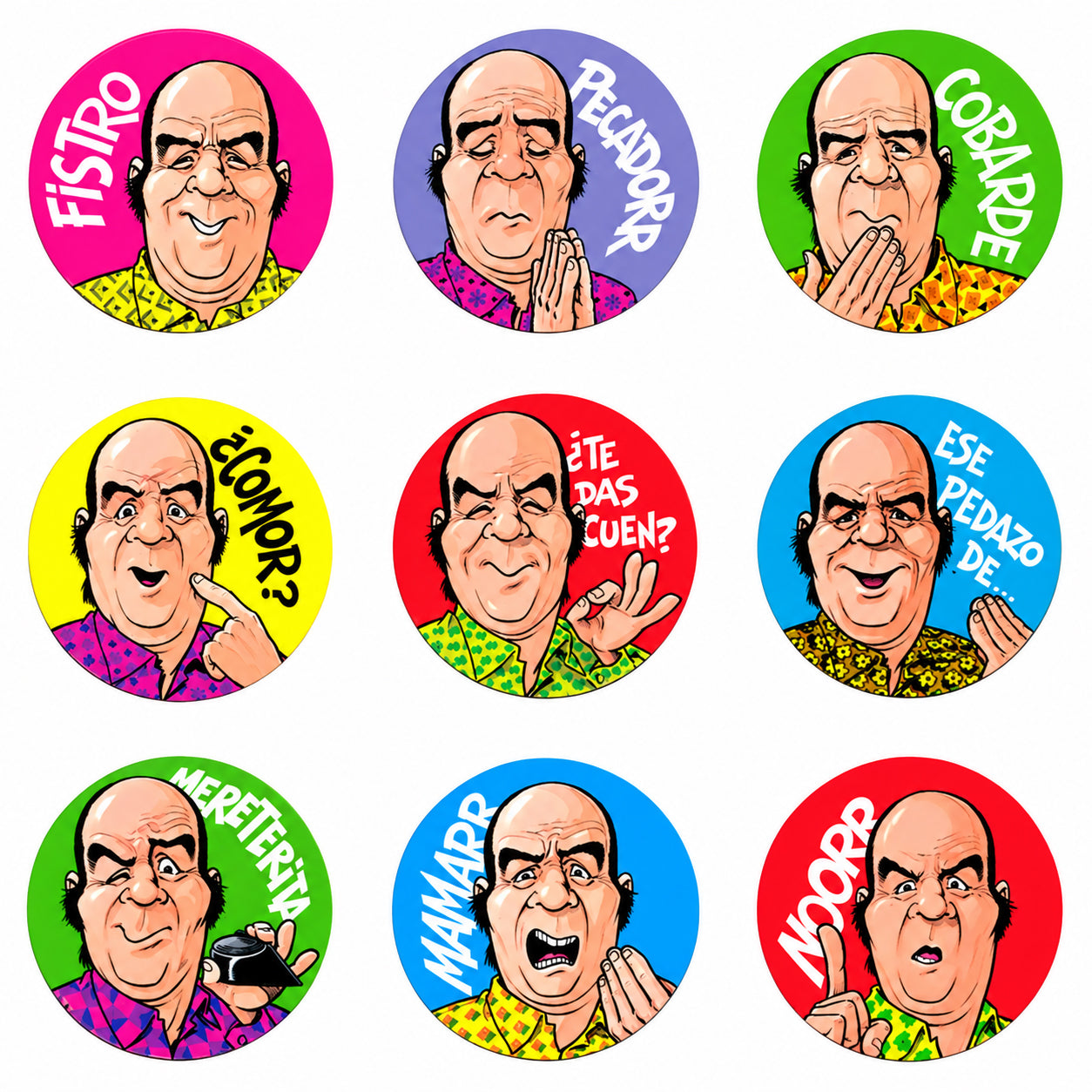
Jose Antonio Carravilla BlancoFistro, pecador, jarl, no puedor, cobarde, quietor, al ataquer... You don’t need to open a dictionary to understand these words. You just need to have listened to Chiquito de la Calzada at least once.
The comedian from Malaga achieved something within reach of very few: inventing a way of speaking that half of Spain ended up using.
His jokes might have been simple, but between one story and another, impossible words, sounds, pauses, distortions of the Spanish language, and expressions that only made sense when spoken with his peculiar intonation would appear.
But what does fistro really mean? Where does jarl come from? What did he mean when he called someone a pecador de la pradera (sinner of the prairie)?
Welcome to the unique dictionary of Chiquito de la Calzada.
Who was Chiquito de la Calzada?
Before becoming one of Spain's most famous comedians, Gregorio Esteban Sánchez Fernández, known artistically as Chiquito de la Calzada, spent a good part of his life working as a flamenco singer.
Television fame came to him when he was already over 60.
In 1994, he began appearing on the Antena 3 program Genio y figura, and his way of telling jokes sparked an immediate phenomenon.
The difference wasn't necessarily the jokes.
It was Chiquito.
His walk, his endless pauses, the little jumps, the hands, the changes in voice, and, above all, that seemingly incomprehensible language transformed any story into something entirely his own.
Thus, a vocabulary was born that would end up becoming part of Spanish popular culture.

What does "fistro" mean?
Fistro is probably Chiquito de la Calzada's most famous word.
And also the most difficult to define.
The reason is simple: fistro never had a concrete and stable meaning.
Chiquito could use it to address someone, describe them, insult them affectionately, or simply insert it into a sentence because it sounded funny.
Depending on the context, it could approximate expressions like "guy," "individual," "character," or even function as a small comic insult.
But trying to translate it literally would be to lose its very charm.
When years later Chiquito himself was asked what it meant, he responded with another one of his witticisms: he claimed it was a "planetary word."
In reality, fistro worked because it didn't need to mean anything at all.
What does "pecador" or "pecador de la pradera" mean?
"¡Pecador!" (Sinner!) was one of his favorite ways to address another person.
It didn't necessarily have a religious meaning, nor did it imply that he was accusing someone of having committed a sin.
Chiquito used it as a humorous term of address, much like someone saying "dude," "friend," "character," or "oddball."
The expression grew until it became the unforgettable:
"¡Pecador de la pradera!" (Sinner of the prairie!)
The combination is deliberately absurd. The "prairie" doesn't provide a concrete explanation: it simply turns an ordinary word into an unmistakably "Chiquito-esque" expression.
Its success was such that it even ended up appearing in the title of one of his movies: Aquí llega Condemor, el pecador de la pradera.
What does "jarl" mean?
Jarl, also usually spelled as "jarrl," is another case where looking for an exact translation leads to a dead end.
It wasn't a word with its own definition, but rather an exclamation.
It could appear after a sentence, between two parts of a joke, or simply as one of those sounds with which Chiquito interrupted his own narration.
Its function was similar to a shout of surprise, effort, confusion, or emphasis, although it could practically serve for any situation.
The key wasn't in knowing what it meant.
The key was to listen:
¡Jarl!
What does "no puedor" mean?
Here, the mystery is much smaller.
"No puedor" is simply Chiquito's peculiar distortion of "no puedo" (I can't).
The addition of that final 'r' turned a completely normal expression into one of his most recognizable catchphrases.
It usually appeared repeated:
"¡No puedor, no puedor!"
Over time, it left his jokes and began to be used in everyday conversations to express exhaustion, disbelief, desperation, or simply to make a humorous reference to Chiquito.
What did "cobarde" mean?
The word "cobarde" (coward) obviously exists.
But after Chiquito, it never sounded exactly the same again.
His famous "¡cobarderrr!" functioned as an accusation, a punchline, or a call for attention.
He could direct it at a character in a joke, the audience, or practically anyone who appeared in the story.
And it was often combined with other expressions:
"¡Fistro! ¡Pecador! ¡Cobarde!"
More than the meaning of the word, what remained etched in memory was his way of pronouncing it.
What does "¿te das cuen?" mean?
"¿Te das cuen?" clearly comes from "¿te das cuenta?" (do you realize?).
Chiquito eliminated the final part and turned a common phrase into another of his hallmarks.
He used it to check that the listener was following the story or to emphasize an idea.
Outside of his jokes, it ended up functioning exactly the same way.
Someone explains something obvious, looks at the other person, and ends with:
"¿Te das cuen?"
And "cómor"?
Another simple and enormously effective transformation.
"¿Cómor?" was Chiquito's version of "¿cómo?" (how/what?).
It was used in the face of something unexpected, incomprehensible, or surprising.
The added 'r' at the end and, above all, the intonation allowed one of the most common words in Spanish to immediately become a reference to the comedian.
What are "condemor" and "grijandemor"?
Here we return to the territory of words without a dictionary.
Condemor and grijandemor were part of that invented vocabulary that Chiquito introduced into his stories without needing to explain anything.
There is no precise translation that would allow one to say they always meant a specific thing.
Their function was fundamentally comic and sonic.
"Condemor" ended up achieving such popularity that Chiquito used the name for his cinematic character in Aquí llega Condemor, el pecador de la pradera.

What does "al ataquer" mean?
"¡Al ataquer!" is the Chiquito-esque version of "¡al ataque!" (to the attack!).
It served to jump into action, start something, or simply add absurd energy to a situation.
It is another display of one of his favorite linguistic resources: adding unexpected endings to perfectly normal words.
Over time, it began to be used outside of the jokes as a humorous way of saying "let's go."
What does "quietor" mean?
"Quietor" comes from "quieto" (still/quiet).
Chiquito could use it as a command:
"¡Quietor!"
And it also appeared in another of his characteristic expressions:
"¡Cuidadín, quietor!"
Again, the mechanism is simple: an everyday word slightly distorted until it becomes immediately recognizable.
What does "hasta luego, Lucas" mean?
"Hasta luego, Lucas" became one of the most famous goodbyes of the 90s.
Its literal meaning has no mystery: it simply means "see you later."
The importance lies in the rhyme and the rhythm.
"Lucas" allows for a common farewell to be turned into a catchy and easy-to-remember phrase.
There is no need for a "Lucas" to exist.
Like much of Chiquito's language, musicality is more important than logic.
What does "por la gloria de mi madre" mean?
Unlike many of his invented words, "por la gloria de mi madre" (by my mother's glory) has a perfectly recognizable meaning.
It is an emphatic expression used to reinforce what is being said, similar to swearing something by a loved one.
But Chiquito turned it into one of his great catchphrases thanks to the frequency, the pauses, and the solemnity with which he pronounced it.
He was capable of using it even in the middle of the most absurd situation.
And "diodenarl" or "duodeno sexual"?
Chiquito also enjoyed mixing real words with completely unexpected endings or combinations.
Hence expressions like "diodenarl," "duodeno sexual" (sexual duodenum), and other variants that appeared in his performances.
The duodenum exists, of course: it is a part of the digestive system.
But in Chiquito's mouth, it ceased to be anatomy and simply became material to construct absurd language.
That was part of his method: choose a word that sounded funny and place it where no one expected to find it.
What did "a güan, a peich, agromenáuer" mean?
Probably nothing that can be reliably translated.
It was Chiquito's particular pseudo-English, constructed from sounds that imitated how the English language might sound.
The expression is usually remembered as:
"A güan, a peich, agromenáuer."
Precisely its charm lies in the fact that it sounds like he is saying something in another language when, in reality, the phrase doesn't need to have a coherent meaning.
Why did Chiquito add "r" to so many words?
No puedor. Cómor. Quietor. Ataquer.
One of the most recognizable characteristics of his language was altering the endings of words.
He didn't follow an exact grammatical rule.
It was fundamentally a sonic resource.
The prolonged 'r's, the pauses, and the distortions allowed any normal word to acquire Chiquito's rhythm.
That is why imitating him doesn't just consist of repeating his phrases.
You have to pronounce them like him.

Why did we find words that meant nothing funny?
Because Chiquito's true language was not only in the words.
It was in the rhythm, the intonation, the silences, the gestures, and the body movement.
He could stop a joke for several seconds to walk around the stage, toss out a "jarl," look at the audience, go back, and continue the story as if nothing had happened.
The invented words served to continuously break the normal rhythm of a conversation.
The viewer never knew when the next fistro, pecador, no puedor, or cobarde would arrive.
And that was a large part of the charm.
Chiquito de la Calzada changed the way we speak
The phenomenon was so big that many of those expressions ended up escaping his performances.
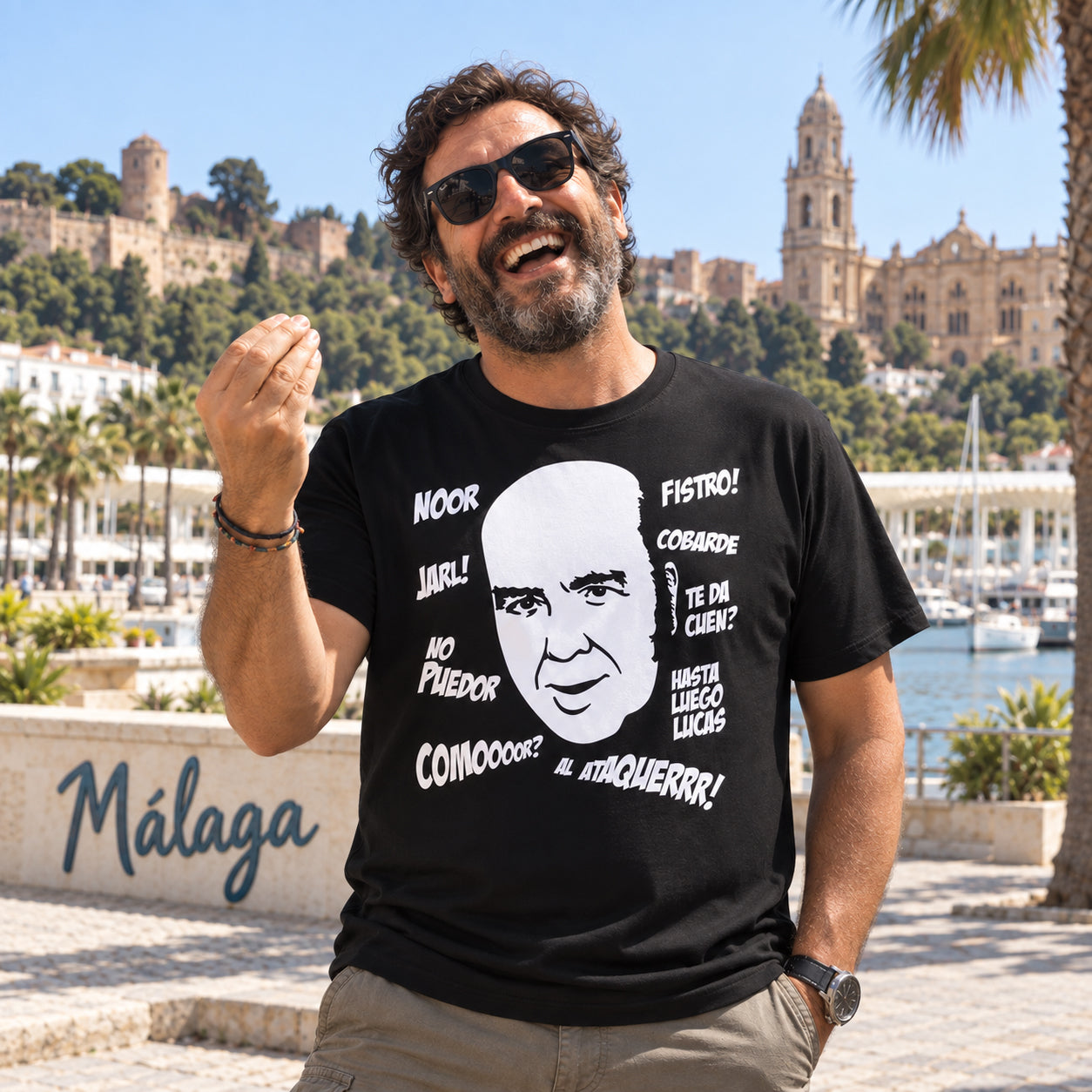
"No puedor," "hasta luego, Lucas," "al ataquer," "fistro," "cobarde," or "¿te das cuen?" began to be heard in conversations between people who were simply imitating the comedian.
Decades later, some are still used even by people who barely remember where they come from.
That is probably one of the best proofs of his influence.
Chiquito didn't just create a collection of famous phrases.
He created a way of speaking that became part of the collective memory of several generations. And perhaps therein lay his true genius: he managed to get millions of people to understand a language that, in reality, had never existed.
If you are also one of those who still let out an occasional "no puedor," "fistro," or "pecador," you can find more references to Spanish humor, film, and television in our collection of "españolada" t-shirts.