

What does "The apple doesn't fall far from the tree" mean? Origin and meaning of the saying
Jose Antonio Carravilla BlancoYou have surely heard the saying "Like father, like son" (literally: "From such a stick, such a splinter") after discovering that a child has the same personality, the same mannerisms, or even the same hobbies as their father or mother.
It is one of those proverbs that practically explains itself, but behind its few words lies an idea that has been repeated for generations: what comes from an origin tends to retain part of its characteristics.
What does "De tal palo, tal astilla" mean?
The proverb "De tal palo, tal astilla" is mainly used to point out the resemblance between parents and children.
It can refer to physical traits, personality, habits, skills, hobbies, or ways of behaving.
For example, if a mother is very fond of music and her daughter ends up sharing that same passion, someone might comment:
"De tal palo, tal astilla."
The Cervantes Virtual Center summarizes its meaning by indicating that, in general, personality and customs are transmitted from parents to children. The expression can also be used more broadly for anything that resembles that from which it originates.
Why talk about a stick and a splinter?
The explanation lies in a very simple metaphor.
A splinter is a small fragment that breaks off from a piece of wood. Since it comes from the same stick, it retains characteristics such as its color, texture, or hardness.
The proverb transfers that image to people:
the stick represents the origin and the splinter that which proceeds from it.
That is why the phrase works especially well to describe the resemblance between generations.
What is the origin of "De tal palo, tal astilla"?
There is no specific date or author that can be attributed with certainty to the proverb. It is part of the oral tradition and, as happens with many popular expressions, it has been passed down from generation to generation.
The Cervantes Virtual Center includes the expression as a commonly used proverb and points precisely to oral tradition as its source.
We also know that in 1885 José María de Pereda published a novel titled De tal palo, tal astilla, which shows that the expression was already perfectly established in 19th-century Spanish.
Is it only used for good things?
No.
"De tal palo, tal astilla" can have a positive, negative, or simply descriptive meaning.
It can be used to highlight a skill:
His father was a great cook and so is he. Like father, like son.
But also to point out a flaw:
She is just as stubborn as her mother. Like mother, like daughter.
Everything depends on the context and the tone with which it is used.
Examples of "De tal palo, tal astilla"
These are some simple examples:
- His father played soccer and now the boy won't leave the ball alone. Like father, like son.
- Claudia has the exact same sense of humor as her mother. Like mother, like daughter.
- They are both just as competitive. Like father, like son.
- Her grandfather was a musician, her father was too, and now she plays the piano. Like father, like daughter.
What expressions mean something similar?
Spanish has quite a few proverbs related to family heritage and the resemblance between generations.
Among the closest we find:
- "Cual es el padre, tal es el hijo" (Like father, like son).
- "De tal árbol, tal ramo" (From such a tree, such a branch).
- "De tal parra, tal racimo" (From such a vine, such a cluster).
- "De casta le viene al galgo" (It comes from the breed to the greyhound).
They all share a similar idea: our origin leaves a mark on who we are.
How do you say "De tal palo, tal astilla" in English?
In English, there is the expression "Like father, like son".
Also very well known is "The apple doesn’t fall far from the tree".
Although they change the wood for trees, fruits, or families, the message is practically the same: the new generations tend to retain something of those who preceded them.
A proverb that keeps working generation after generation
Perhaps "De tal palo, tal astilla" continues to be used so much because it describes a very everyday scene: recognizing a father or a mother in the way their children are.
A gesture, a hobby, an expression, or a way of behaving can be enough to utter those five words.
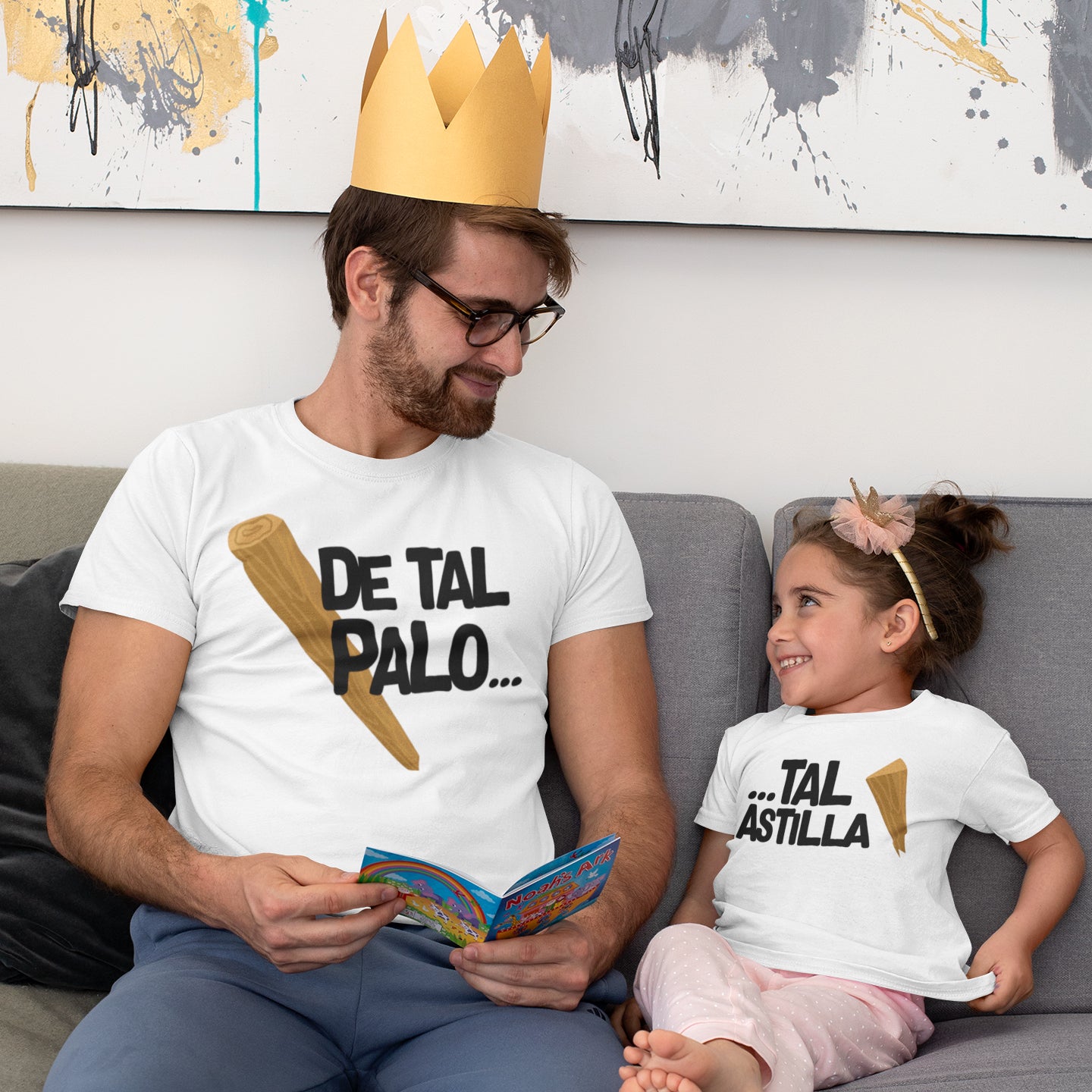
And precisely that family complicity also made the proverb a perfect idea for matching designs.
At Siempre Original you can find our De Tal Palo design and combine it with Tal Astilla, in addition to other designs within our collection of matching t-shirts for parents and children.