

What is ring-spun cotton and why is it used in t-shirts?
Jose Antonio Carravilla BlancoWhen you read the features of a t-shirt, you might come across expressions such as "100% cotton," "combed cotton," or "ring-spun cotton." But what does the latter actually mean?
The English term ring-spun refers to the way cotton fibers are transformed into yarn before the fabric is made.
It may seem like a purely technical detail, but the spinning system directly influences characteristics that we can indeed notice when wearing a t-shirt: softness, uniformity, durability, and printing surface.
That is why ring-spun cotton is widely used in t-shirts intended for both daily wear and graphic printing.
What does ring-spun cotton mean?
Ring-spun literally means "spun in a ring."
It is a manufacturing system in which cotton fibers are progressively stretched and twisted to form a continuous yarn.
During this process, the fibers become more aligned and compacted around the yarn.
The result is a yarn that can be fine, resistant, and pleasant to the touch, characteristics that are especially interesting when it is subsequently used to manufacture t-shirts.
Therefore, when you find the expression "ring-spun cotton" on a product sheet, it is not talking about a different type of cotton, but about the method used to convert the fibers into yarn.
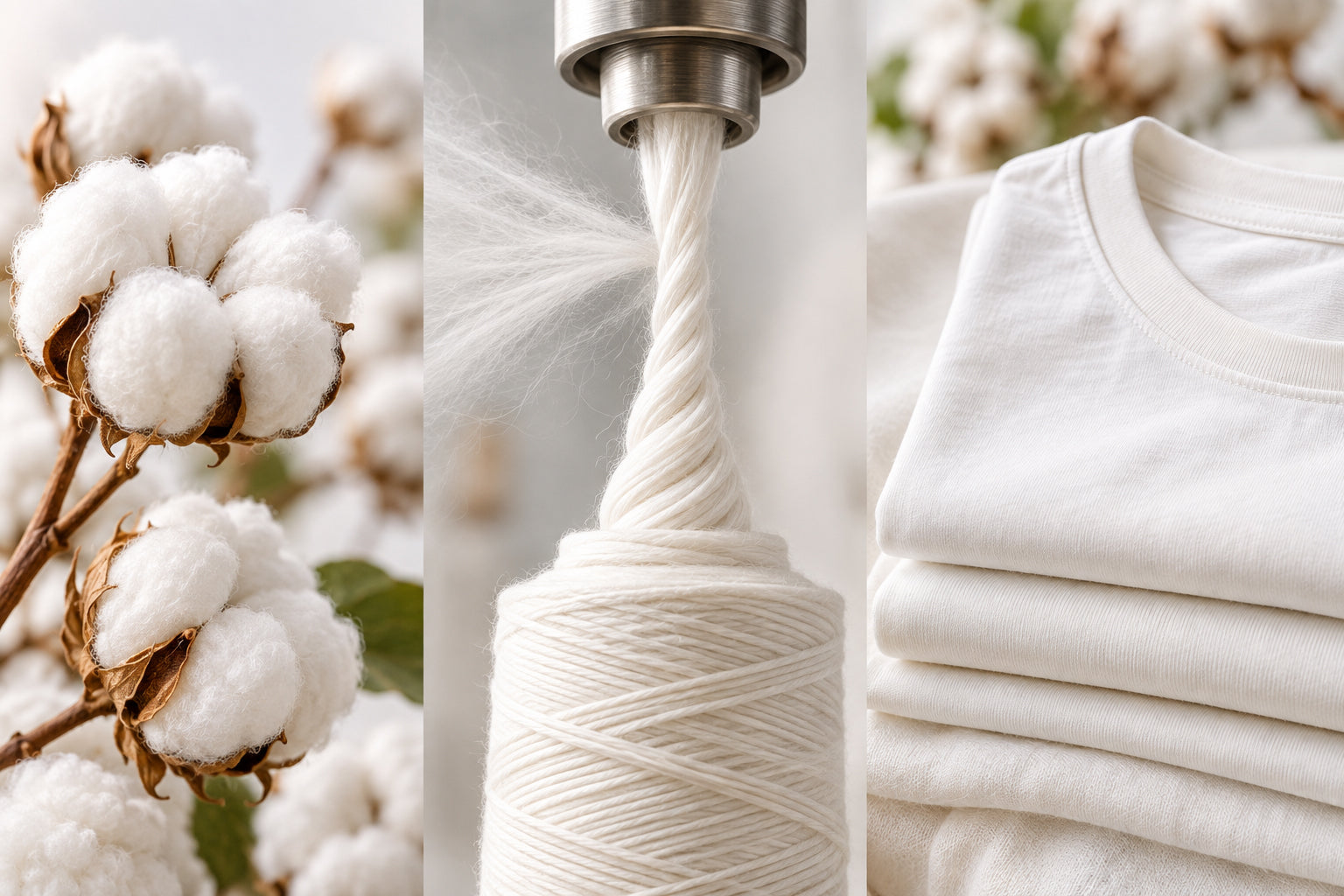
How is ring-spun cotton made?
Before becoming a t-shirt, cotton goes through different processes until it is first transformed into yarn and then into fabric.
In the ring-spun system, previously prepared fibers pass through a series of rollers that stretch them progressively.
Then, twist is applied while the yarn is wound around a bobbin using a system formed by a ring and a small moving element.
That is precisely where the name ring spinning comes from.
The twist allows the fibers to remain joined, forming a continuous yarn.
This system is slower than other industrial spinning methods, but it allows for the production of a very wide range of yarn thicknesses and fabrics with an especially soft touch.
Why is ring-spun cotton usually softer?
Softness depends on many factors, including the quality of the fiber, the weave, the finishes, and the spinning system itself.
But ring-spun has an important advantage: the fibers are stretched and twisted in such a way that they form a relatively uniform and compact yarn.
This allows for the manufacture of fabrics with a soft surface that is pleasant to the touch against the skin.
This does not mean that every ring-spun t-shirt will automatically be excellent. The final quality still depends on the cotton used, the fabric construction, the weight, and the finishes.
But it is indeed a feature that can significantly contribute to the feel and comfort of a t-shirt.
Ring-spun vs. open-end: what is the difference?
Another common system for manufacturing cotton yarn is called open-end or rotor.
Open-end allows yarn to be manufactured much faster and more efficiently, which is especially interesting for certain high-volume productions.
Ring-spun requires more steps and generally operates at a lower production speed.
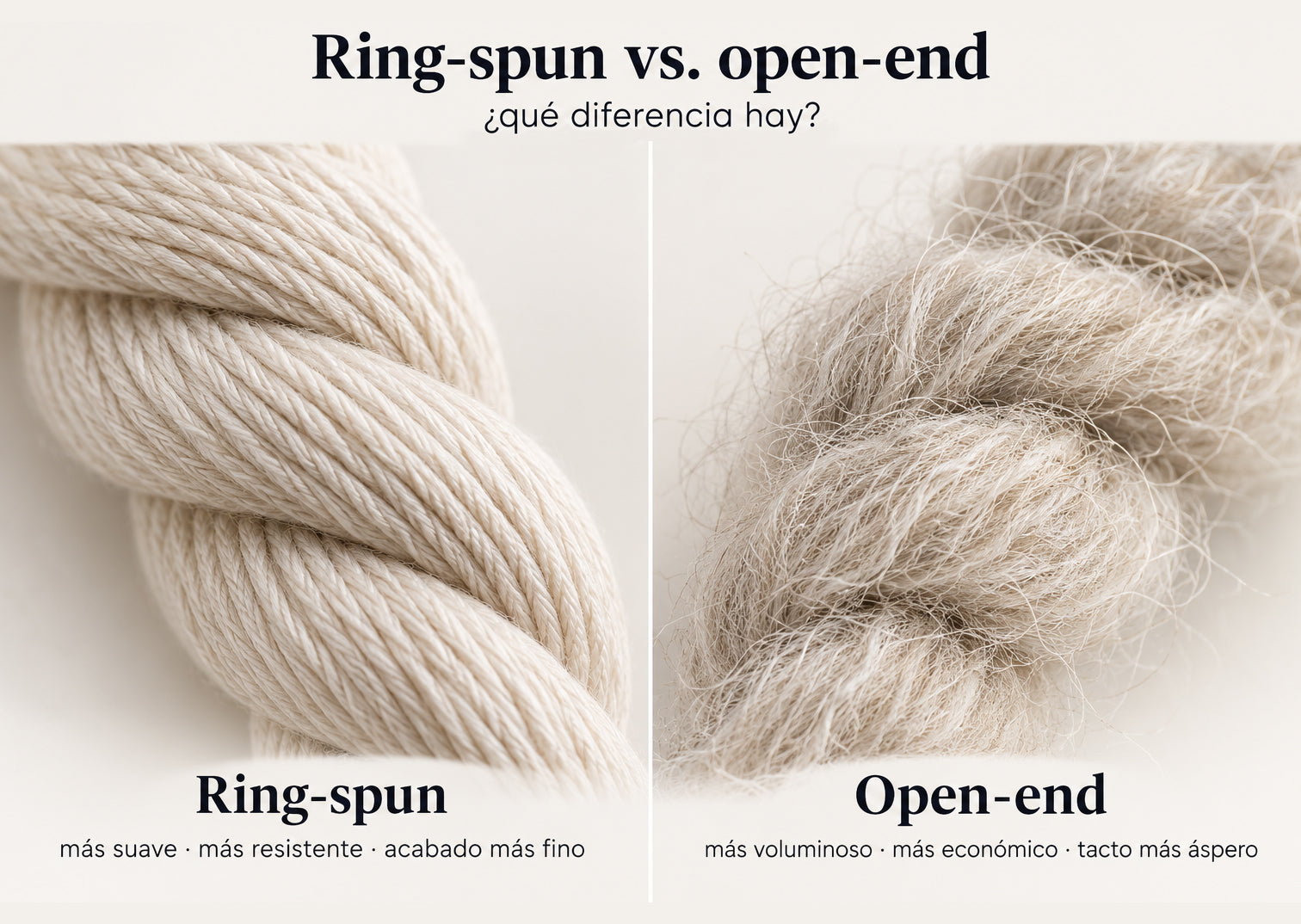
The difference can be appreciated in the structure of the yarn.
Ring-spun yarn usually allows for finer, stronger, and softer yarns, whereas open-end systems are especially efficient at producing certain thicker yarns.
That does not mean that open-end is a "bad" material. They are simply two different spinning technologies, each with advantages depending on the type of fabric one wishes to manufacture.
For a graphic t-shirt where we are looking for comfort and a relatively uniform surface, ring-spun is particularly interesting.
Are ring-spun cotton and combed cotton the same?
No. They are related concepts, but they describe different processes.
Ring-spun indicates how the cotton is spun.
Combed indicates an additional process of preparing the fibers.
During combing, some of the shorter fibers and certain impurities are removed before the yarn is manufactured.
That is why it is common to find the expression "combed and ring-spun cotton."
In that case, the cotton has gone through both processes.
What is the relationship between ring-spun and fabric weight?
Here it is advisable to separate two concepts that are often mixed up.
Fabric weight indicates how much one square meter of fabric weighs.
The term ring-spun, on the other hand, describes the method used to manufacture the yarn.
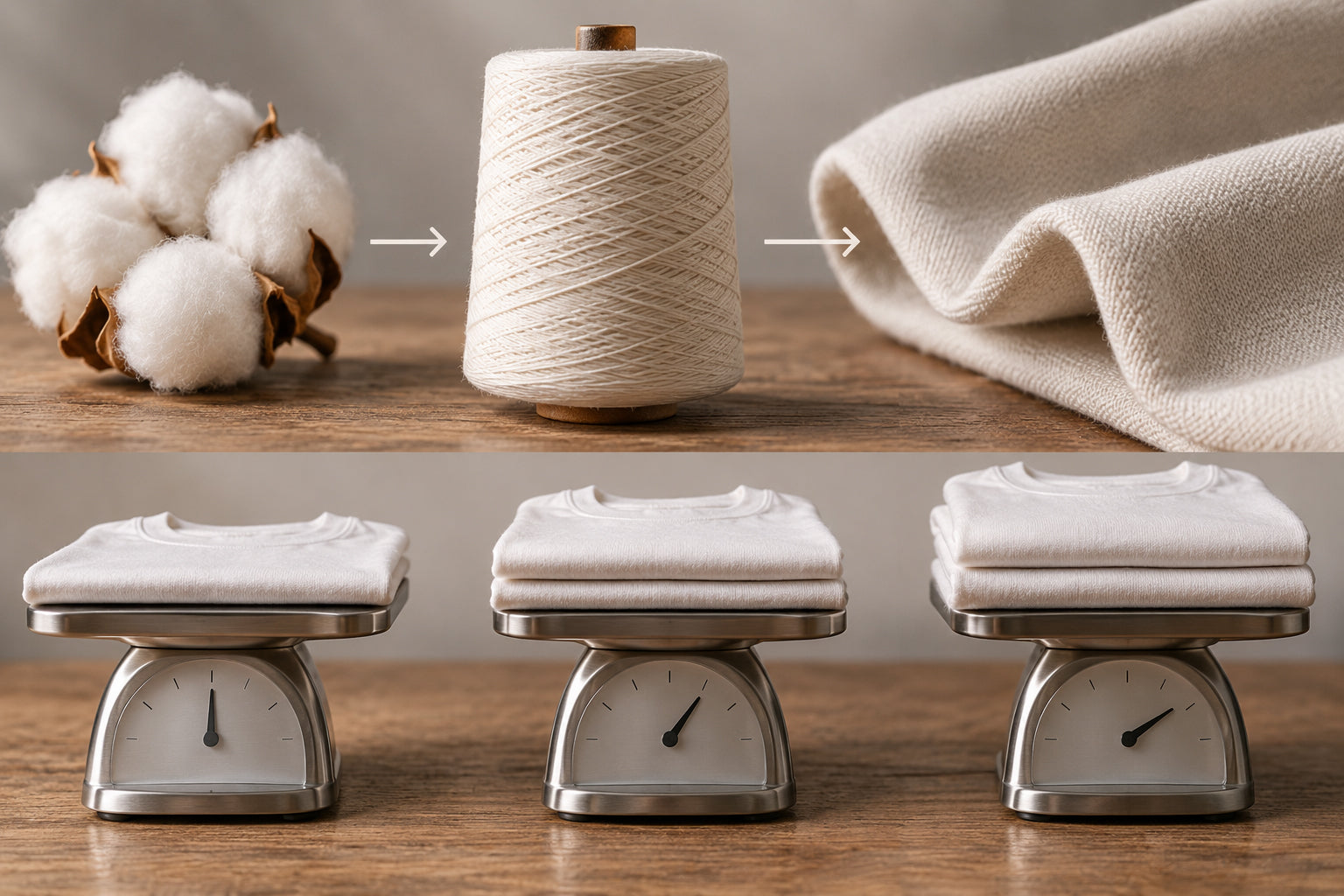
Therefore, a t-shirt can have a relatively light weight and be made with good-quality ring-spun cotton.
And a heavier-weight t-shirt does not necessarily have to use better yarn.
That is why more grams does not automatically mean higher quality.
The final result depends on the combination of different factors: cotton, type of yarn, fabric construction, weight, and finishes.
If you want to better understand this difference, in our guide on what weight a good t-shirt should have, we explain what values like 140, 150, 180, or 200 g/m² really mean.
Can a lightweight t-shirt be of good quality?
Yes.
One of the most common mistakes when evaluating a t-shirt is using only its weight as an indicator of quality.
A lightweight t-shirt can use fine, soft, and well-constructed yarns, while a heavy t-shirt simply contains a greater amount of material per square meter.
They are different characteristics.
In fact, a lightweight fabric can be especially comfortable when we are looking for breathability, softness, and a pleasant garment to use for a good part of the year.
That is why at Siempre Original we work with light or medium-light weight t-shirts, combining them with ring-spun cotton.
Why does ring-spun cotton work well for printing t-shirts?
In a printed t-shirt, it is not only the illustration that matters.
The surface on which it is printed also matters a lot.
A relatively uniform fabric allows for the reproduction of lines, colors, and small details with greater precision.
Ring-spun cotton can provide a soft and regular surface, which is especially useful for direct-to-garment printing techniques.
This is especially important in complex designs with gradients, portraits, textures, illustrations, and numerous colors.
At Siempre Original, we use professional DTG printing, so the combination of a good cotton surface and high-definition digital printing is especially important.
If you want to know the differences between printing techniques, you can consult our guide DTG vs. screen printing: differences, advantages, and durability.

Is ring-spun cotton stronger?
The twisting process used in ring-spun helps create a yarn with good cohesion between the fibers.
Yarns produced through this system can offer high strength in relation to their thickness.
But, just as with softness, the durability of a t-shirt does not depend exclusively on whether it uses ring-spun cotton.
Fabric construction, seams, weight, washing, drying, and usage also play a role.
Therefore, it would be incorrect to state that any ring-spun t-shirt will necessarily last longer than any other t-shirt.
The correct approach is to consider the spinning system as one of the elements that contribute to the overall quality of the garment.
So, is ring-spun cotton better?
There is no single characteristic capable of determining on its own whether a t-shirt is good or bad.
But ring-spun cotton offers qualities that are especially interesting for this type of garment.
It allows for the manufacture of fine and strong yarns, contributes to achieving a soft feel, and provides a uniform surface especially suitable for printed t-shirts.
That is why it is used so much in garments where comfort and print quality are of particular importance.
The next time you read "100% ring-spun cotton" on a label or product sheet, you now know that it is not simply referring to the percentage of cotton.
It is also telling you how that fiber was turned into the yarn with which the t-shirt was finally manufactured.